Saturday, December 23, 2006

Deep in my heart I still believe

I havent posted lyrics in a quite a while. The past year has been difficult for the motherland, for the world. Wars, rumors of wars, famine, pestilence. Death. So much death. And so for all of us, for every one of us who dreams of something better, for something purer, something more beautiful, and have never given up on that dream, who continue to work and to pray for them, our dreams for ourselves and everyone else, here's

We Shall Overcome

We shall overcome
We shall overcome
We shall overcome some day

Oh, deep in my heart
I do believe
We shall overcome some day

We'll walk hand in hand
We'll walk hand in hand some day

Oh, deep in my heart
I do believe
We shall overcome some day

We shall all be free
We shall all be free some day

Oh, deep in my heart
I do believe
We shall overcome some day

We are not afraid
We are not afraid
We are not afraid some day

Oh, deep in my heart
I do believe
We shall overcome some day

We are not alone
We are not alone
We are not alone some day

Oh, deep in my heart
I do believe
We shall overcome some day

The whole wide world around
The whole wide world around some day

Oh, deep in my heart
I do believe
We shall overcome some day

We shall overcome
We shall overcome
We shall overcome some day

Oh, deep in my heart
I do believe
We shall overcome some day

Happy new year.

Monday, December 18, 2006

The universe in a grain of sand

A comment on my entry (un)Intelligent Discussion got me thinking about the intelligent design of hurricanes. I told the commenter that I wasnt aware of any such theory from the media. It turns out that scientists--mainstream scientists--have their own theories of the intelligent design of the entire universe, although I suspect they dont consider themselves ID proponents, or will not admit to being one publicly.

Consider this article in Slate dated 19 May 2004. Jim Holt interviews Stanford University physicist Andrei Linde. Linde proposes that it is possible that intelligent beings from another civilization could create a universe.

"When I invented chaotic inflation theory, I found that the only thing you needed to get a universe like ours started is a hundred-thousandth of a gram of matter," Linde told me in his Russian-accented English when I reached him by phone at Stanford. "That's enough to create a small chunk of vacuum that blows up into the billions and billions of galaxies we see around us. It looks like cheating, but that's how the inflation theory works—all the matter in the universe gets created from the negative energy of the gravitational field. So, what's to stop us from creating a universe in a lab? We would be like gods!...What my theoretical argument shows...is that we can't rule out the possibility that our own universe was created in a lab by someone in another universe who just felt like doing it."
Lindt even proposes ways in which this universe creator could communicate with his creation using the language of physics, that is, by designing parameters in the universe that intelligent creatures that might arise in it could decipher from the physical evidence. A sort of clue or code that would tell the 'people' there that this was the work of some intelligent being. From the article:
...the creator, by fixing certain values for these dozens of constants, could write a subtle message into the very structure of the universe. And, as Linde hastened to point out, such a message would be legible only to physicists.
That is exactly what ID biologists are trying to point out: that the very structure of living things point to an intelligent entity who left instructions on how to build living, replicating things. I mentioned irreducible complexity in the comments section, a term coined by biochemist Michael Behe. He points out that at the biochemical level, a level Darwin wasnt able to observe since the technology didnt exist yet when he was formulating his groundbreaking theory, one would find that processes that makes the cell run for example couldnt have come from a slow, random process, but from a 'conscious' following of an instruction set. The technical stuff of this theory is way over my head, but as I understand it, irreducible complexity can be illustrated thus:

Given a cellular organism with biological processes we'll call ABCDEFG, wherein A,B,C,D,E,F, and G are processes within the overall process, the organism will cease to function if any one of these processes is absent. Pretty simple. The reason Behe concludes that this is evidence for design is that it couldnt have come from a gradual, random process. In the primordial ooze for example, ABCDEG couldnt have survived and propagated long enough to randomly mutate the F process. A couldnt have survived to randomly acquire B, AB couldnt have survived to randomly acquire ABC, etc. And the odds that a random mutation caused A,B,C,D,E,F, and G to come together to build an organism are so large, it's practically impossible. Hence, he concludes that the process was following instructions. ID proponents are simply using accepted scientific methods for determining whether something was designed or not (by, for example the scientists from the SETI project), and turning them towards terrestrial life.

The thing that irks anti-ID scientists is the idea that ID is providing Creationists a veneer of scientific legitimacy. In fact, most of them accuse ID as being Creationism in disguise, therefore preventing curious scientists from looking into it, fearing reprisal. ID scientists, in a case of logical double standard, are pilloried for espousing philosophical ideas masquerading as science, while at the same time scientists like Richard Dawkins are given a pass for espousing equally philosophical ideas (in this case, atheism) even though a scientist's personal philosophy has little to do with the evidence.

I should point out that my view that intelligent design is worthy of investigation is based on logical consistency and not on my understanding of the science involved. I just get my information from the media. If mainstream scientists like Andrei Linde and Brian Greene believe that a universe can be designed, why is it not possible for our universe and the life in it to have been designed as well?

Thursday, December 07, 2006

The Fall of the Rebel Angels in the city of the pissing little boy

I managed to schedule a trip to Brussels on the 25th of November. Just a day trip. More like a preliminary exploration of the place for when I get back. I was informed at the ticket counter that work was being done on the rails so I have to take 3 trains instead of the usual two: Utrecht to 's-Hertogenbosch, 's-Hertogenbosch to Roosendaal, then Roosendaal to Brussels. I was supposed to be in Brussels by one in the afternoon, but delays on all three trains got me there an hour and a half late, and with the shortened daylight hours, I knew I wouldnt be able to take pictures worth crap. Anyway, I got to Brussels Central station, and hopped on a City Tours bus to get a bird's eye view of some of the places I intend to visit, inshallah, when I get back.

By the time I got back to the Central Station, it was almost 4. The Museum of Fine Arts closes at 5 so I hightailed it over there and went in. An American man was on his way out and I almost ran into him. "Need tickets?," he asked. Yes, I said. "Here," he handed me 2 tickets. "Some of my pals didnt make it." Ok, how much for one? "Nah, take them. We won't be able to use them." Thanks. At the entrance a nice old lady gave me a map of the museums (there are 2 of them: one for ancient art and one for modern art, joined together). "What do you want to see?," she asked. We're closing at 5 so you won't be able to see them all." Rubens and Bruegel, I said. And she pointed to their display rooms on the map. I skimmed through the Rubenses. I really wanted to see the Bruegels (both Pieters), although Brussels didnt have a large collection. I didnt need a large collection since I didnt have that much time. I liked them because they were un-Italian, and therefore to me, a bit quirky. Their style is more primitive; cartoony even.

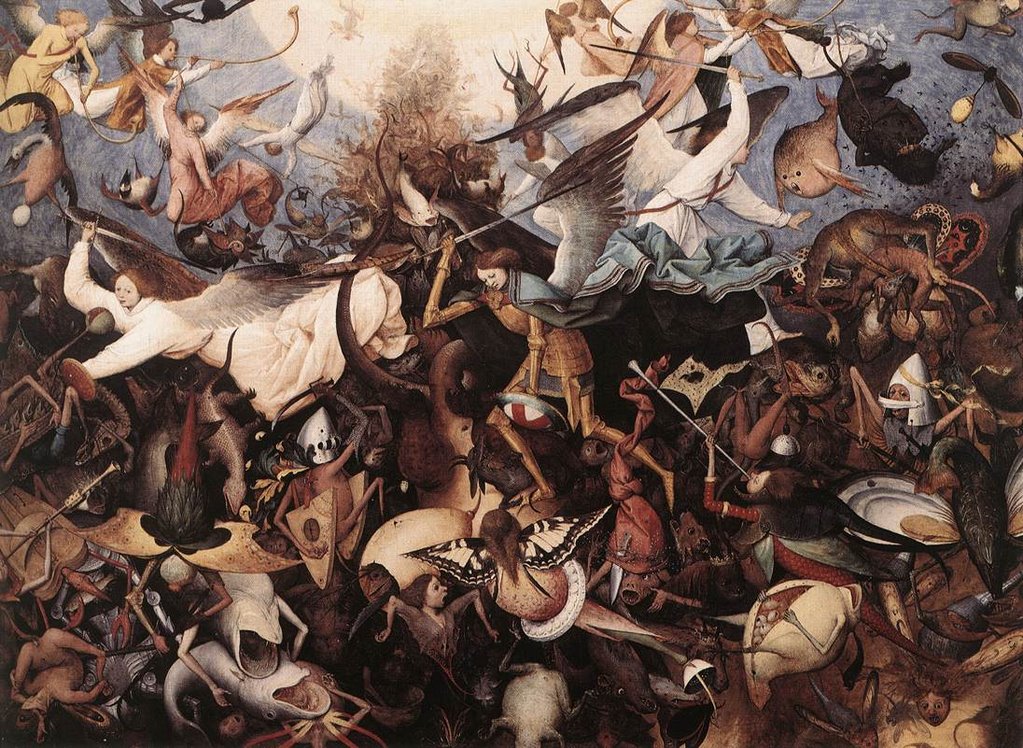
Then I came upon Pieter the Elder's The Fall of the Rebel Angels and went, Holy crap! Give me whatever it is this guy was smoking.


Pieter the elder wouldve been right at home working in Japanese animation. The painting is a wonderful, bizarre portrayal of Michael's battle with the fallen angels. (There's Michael in the middle, with long spindly legs, in the process of kicking some dragon-like creature's ass.) The monsters are an assortment of reptiles, insects, fish, frogs... I even spotted what looked like fruit in there somewhere--monster fruit! Killer pomegranates! Run for your lives!!

I was mesmerized. For comparison, take a look at Peter Paul Rubens's version here.

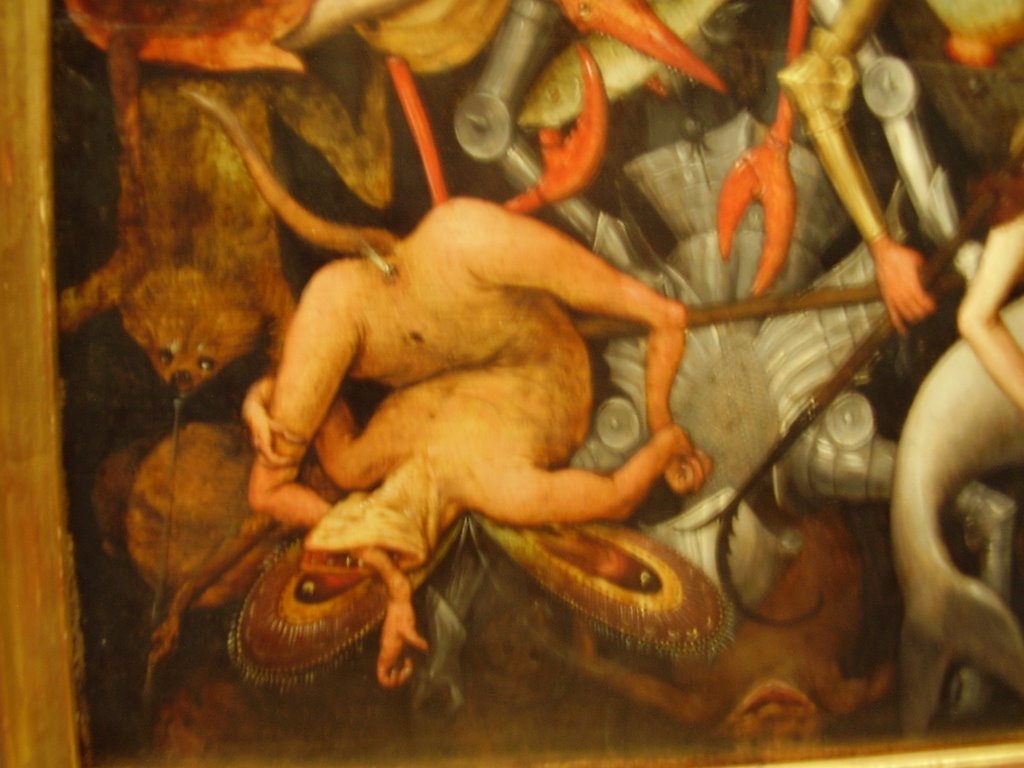
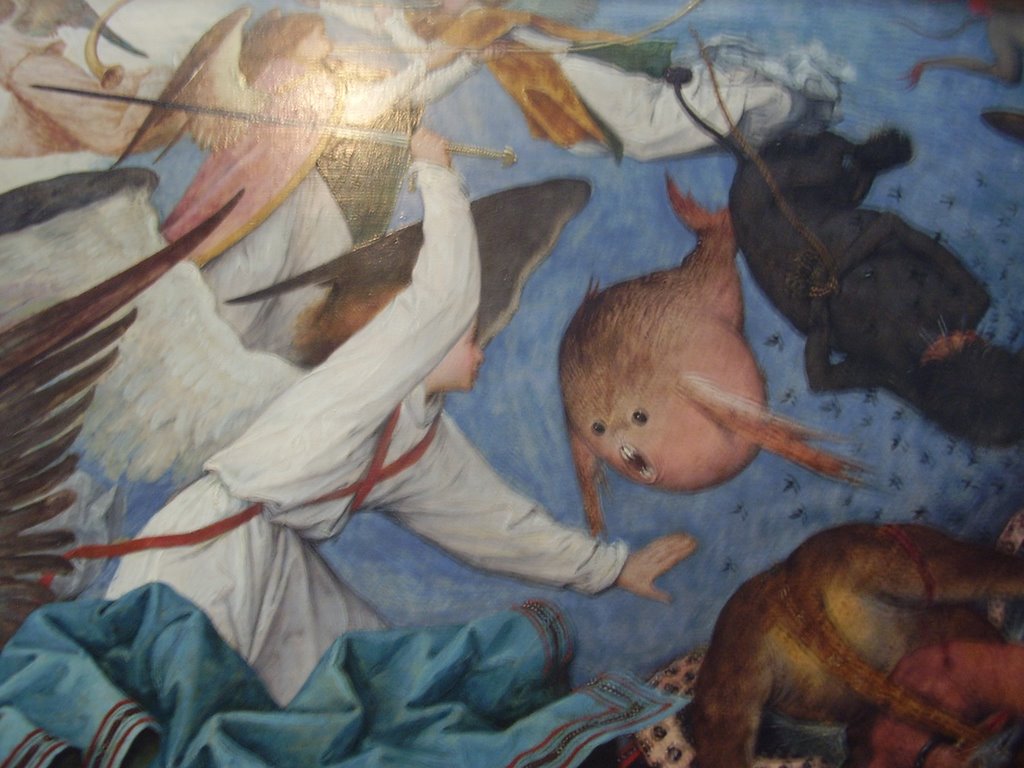
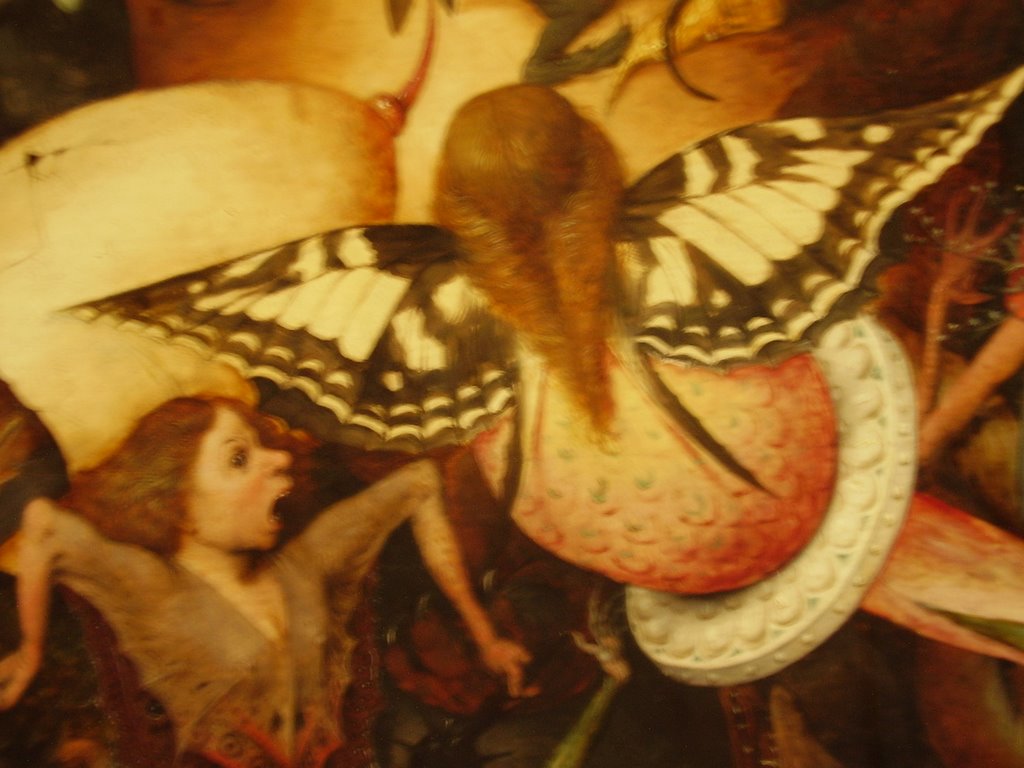
Here are some details of the painting.

Take a look at that lizard man's ass. Is that light coming out
of his bunghole?


Die, flying furry fish creature!


Butterfly lychee monster of doom

Got out at closing time to the delicious smell of Belgian waffles. But waffles can wait. I have to try the beer. The raspberry Kriek was good, but I have to say the White beer is my favorite. Made from wheat, and flavored with herbs and orange peel. Yum. Served with lemon.

Mussels in Brussels? Not on this trip. Although Brussels is known for its mussels in white wine and there were rows and rows of restaurants serving them, with fries a la Belgique on the side, I didnt have a chance to try them. I was going to, but on my way to the Grand Place, I spotted this small Tunisian tea house with a delicious display of pastries and I just had to get in. I had a tea made from fresh mint leaves and one--ok two--pastries: sweet filo dough around a creamy center with a hint of rose water. Damn, that was good. By the time I reached the brasseries, I didnthave enough room for the mussels. Besides, they serve them in big buckets and I dont think I can finish all of it. Maybe next time. I tried the street food instead: escargot in broth. Take that, orange eggs and fishballs.

There are a lot of things to go back to in Brussels, and maybe someday I will. Any city whose symbol is a pissing little baby is okay in my book.


(Note: The picture of the painting is from the Web Gallery of Art site. The one I took was crap. All the other photos are mine.)

Wednesday, December 06, 2006

English anomaly of the day

I propose to find anomalous practices in the English language and its local mongrel daughter Taglish and post them here as soon as I find them.

1) Which is correct: 'Keep this door open' or 'Keep this door opened.'? Most of the people I asked chose the first, and so would I. Except we say, for apparently no reason at all, 'Keep this door closed.' There is no logical reason we would use a present tense form of the adjectival verb for one, and the past tense form for its opposite. The closest I could come up with is the need to prevent ambiguity between keeping a door shut and keeping a door near, which both use 'close' hence the need to distinguish keeping the door shut by using 'closed.' But that isnt satisfactory. Only a moron would misconstrue nearness with shut-ness. Therefore I will from this day on use 'Keep this door opened' until this anomaly is satisfactorily resolved.

2) The Tagalog prefix 'na-' is used to denote that an action has occured in the past, much like -d or -ed is used to denote simple past perfect tense in English: Open, Opened; Close, Closed. Therefore, if one uses na- in Taglish, one doesnt need to use the past tense form in the English part of the word or phrase. 'nabore' for bored, 'nabring up' for brought up, 'naforesee' for foresaw, etc. However, in common Taglish usage, one uses, again for no logical reason at all to connote being fed up, the Taglish word 'nafed up.' This is anomalous. Therefore, unless anybody defends the usage of nafed up to me, I will use the more correct nafeed up.

I will try to unearth more anomalies and post them here as they come to me. In the meantime, I enjoin you to use the more correct forms until the issue is satisfactorily resolved. Sure theyll laugh at you, but I ask you, didnt they laugh at Magellan when he proposed to circumnavigate the globe? Didnt they laugh at Copernicus when he proposed that the Earth revolved around the sun? They can laugh at you, but it will be the laughter of the dunces against pure, unadulterated genius. Join me. Let's carve up a little corner of sanity in this wild and crazy world. Keep your minds opened.

Addendum (8 December): It has occured to me that the reason we use nafed up is because there is no infinitive 'to feed up' in English. The infinitive is actually 'to get fed up' (got fed up, getting fed up, will get fed up). Therefore the correct Taglish usage should be naget fed up, and this is the form I will be using henceforth in more formal conversation. Nafed up is acceptable in less formal situations.

Thursday, November 30, 2006

(un)Intelligent Discussion

I caught the tail end of a segment in BBC Two's News Night wherein the host Jeremy Paxman was moderating a discussion between Intelligent Design proponent Professor Andy Mcintosh and Darwinist Professor Lewis Wolpert. And as usual, I think the media has no clue what ID is all about. Neither, I suspect, do Darwinists based on that discussion. Professor Wolpert spent the interview (the part I caught) chanting the Darwinist mantra "ID is just religion" while moderator Jeremy Paxman kept asking Professor Mcintosh, "But who is the designer?"

On the News Night website, they called Truth in Science, the organization that Prof. Mcintosh represents, a Creationist group. I don't know how accurate that is. From what I caught of the interview, TIS isnt a Creationist group but an ID group. The two are different, and this is what the media doesnt seem to get. Creationism is based on a literal interpretation of Genesis (which means Creationists believe all this is created by God--a religious belief). ID is based on a scientific hypothesis based on what these scientists have observed in nature, that the complexity of life on earth could not have come from random events, that the pattern of life on earth seems to be following instructions, and where there are instructions, then there must be some intelligence behind it. That's all. Who is the designer? is not a question an ID proponent could answer scientifically since there is no evidence of the identity of this entity. It could be anybody: God, Nature, little green men, they dont know and dont profess to know. What there is evidence for is that someone did it. Just like CSI. Those forensic scientists in the TV show could look at the evidence and conclude that a death isnt random or accidental based on the evidence: someone did it. The difference of course is that in CSI, the evidence for the identity of the killer can be found. In the case of ID theory, the scientists havent found evidence of who did it. When an ID proponent says, "I believe the designer is God (or Nature, or Steve from next door)," he is making a philosophical or theological statement, not a scientific one. But anti ID people seize upon this and conflate the faith with the science. "See? He believes in God (or Steve)! Therefore ID is a religion." This is illogical and just plain stupid.

I think both sides of the debate have good arguments, but what do I know? But the fact is that when a scientific theory becomes the mainstream, it becomes intolerant of competing theories. Competing theories have to constantly prove themselves against the mainstream. I think that's a good thing. We can't blindly follow every new thing that comes along just because they sound nice or they agree with our own personal belief system. Fledgeling theories have to prove their mettle to gain acceptance. The ID people, knowing that the mainstream view controls the publications where they can gain legitimacy, have taken their case to the public, who can then decide. But they can only decide wisely if the facts are accurately reported by the media but media hasnt done its homework. Or worse, they have already taken a side in this debate.

Tuesday, November 28, 2006

The Ho' train


They call him Sinterklaas over here and he's tall, slim, and wears a cardinal's garb. He doesnt live in the North Pole because he isnt insane. He lives in Spain because it's warm and sunny and because he isnt a whale-and-seal-hunting inuit. Somehow, when he made his way over to New Amsterdam (present day New York City), the lure of the big city got to him and he lived a life of debauchery. He gained weight from all that junk food and beer, and became a crack-dealing pimp. Not a pimp, eh? So tell me, Einstein, why he dresses up in red suede and yells 'Ho, ho, ho' all the time. From what I can tell, he still lives in Spain. He just says he lives in the North Pole to give the Man the slip, daddy-o. And he isnt the first holy man to succumb to the weakness of the flesh. Siddharta Gautama used to be a skinny ascetic from India, then preached moderation, the middle way, til he came to China and got so enamored with the cuisine (and the women) that he became an obese parody of his former self and fathered several children. At the same time. Look at them climbing all over their fat, laughing dad.

(Picture from sinterklaas.goedvinden.nl/)

Friday, November 10, 2006

Salman and the sea of anhedonia

I think I may have turned anhedonic. Ive complained to more than a few people about the lack of pleasure I derive from the cuisine here, whether it be the food in the cafeteria or the shawarma shop or the faux-Chinese food, how the tastes are starting to blend into each other in an amorphous mass of sameness. Oh how I yearn for ginisang munggo. The kind with the thick slabs of those Ilocano chicharon or leftover crispy pata in it. And alugbati. I love those slimy leaves. The fact that I can yearn for munggo clearly shows that Im not anhedonic about food, no sir. The anhedonia Im talking about is an anhedonia about something I normally derive pleasure from, and that's reading. (And here I say a prayer of thanks for the fella who owns Booksale.)

Ive always enjoyed reading ever since I can remember and my mother tells me Ive always enjoyed reading ever since before I can remember. And growing up I never lacked for a supply of stuff to read. My aunt was a librarian in a school in Mendiola and she'd come to our house with stacks of books discarded from the library and give them all to me. And there's always the school library. Even during my street punk days, I never stopped reading, so much so that I earned the nickname Genius from the rest of the gang. (The other nickname was Bonifacio, because, the guy who gave it to me, one of the more senior ones in the old gang, said I was 'sugod ng sugod'. But I wasnt sugod ng sugod. They were always ahead of me when we 'attacked'. I guess he gave me that name because he thought someone who read as much as I did shouldnt even be hanging with them.)

I bought two books over the weekend: Salman Rushdie's Shalimar the Clown and David Eggers's A Heartbreaking Work of Staggering Genius. Shalimar I bought because, well, it's Rushdie, man. I have always been in awe of this guy, whose works are NEVER in Booksale and therefore require considerable monetary commitment, ever since I bought my first Rushdie book, The Ground Beneath Her Feet, which led me to his other works. In fact I credit Salman Rushdie with killing all illusions I have of ever becoming a writer of fiction. (Dan Brown later saved those illusions. The trick, Ive learned, is never to go for greatness when mediocrity would suffice.) A.H.W.S.G. I bought because of the sheer audacity of the title. Ive heard of this book before and ignored it because I normally dont go for memoirs. What makes these people think their lives are any more interesting than those of the rest of us that they would foist it upon the world at large? Besides, memoirs are almost always depressing. But I gave this one a shot.

I started with A.H.W.S.G., and right off the bat it didnt seem right. As I flipped through the pages, I noticed overly long and elaborate Preface and Acknowledgement sections, the length of which screamed Manic-Depressive, plus a section on how to enjoy the book which said the Preface and Acknowledgement sections werent necessary for the enjoyment of the book. Ok, I'll take your word for it, Dave.

It read well enough at first. By the time I got to the cancer, my heart sank. Another depressing memoir. But I read on because Eggers does write well. But when he began describing what he and his mother were watching on TV (while he was holding her bleeding nose), I went, Come on. Do you have to describe what's happening in that episode of Gladiators? It must be a metaphor for something--something I dont get because Im stupid so I read on. But he went on to describe another TV show. I closed the book. See you later, Dave.

I picked up Shalimar the Clown. And it was everything I expected: Rushdie at the top of his game. His words flow like liquid poetry. The narrative just takes you along paths of Rushdie's choosing. He's erudite, he's funny. Usually, I just go along for the ride, but this time something was amiss. The rhythm was growng repetitive. It wasnt a Bollywood musical number anymore. It was a drone. I was drowning in a sea of metaphors. It was an explosion of figures of speech. Im fine with figures of speech. In fact I used a couple in this very paragraph. But to be deluged in it, to be overwhelmed with poetic narrative gone berserk... I went, For the love of God, Salman. Will you just get on with telling me what happened? I closed the book, defeated.

I understand my reaction to the Eggers book, but to the Rushdie book? Have I lost the ability to enjoy myself? Maybe it's the weather: it's cold and it's wet. Perhaps it has something to do with being alone in a foreign land where at this time of year, the sun rises past seven in the morning and it's already dark at five pm. Because this isnt normal to a tropical islander like me. I lack energy. Im gaining weight, and the weight isnt evenly distributed. It seems to be massing in my tummy, my butt, and my jaw. I have fat jaws.

Maybe I miss the family. I find considerable pleasure reading the back of a box of Sunny Boy instant milk powder when I can hear the kids playing. Im not anhedonic at all. I just need to be enjoying myself to enjoy myself. I turn the TV on and fall asleep to CNN.